
Automate Supplier Price Updates Singapore Restaurant Guide
Learn to automate supplier price updates for Singapore restaurants. Adjust recipe costs instantly when prices change, cut food cost errors, and reclaim hours from spreadsheets. Step-by-step for hawker stalls to CBD bistros.
Automate Supplier Price Updates: Ramen Shop in Tanjong Pagar Edition
Your ramen shop at Tanjong Pagar MRT pulls S$25k monthly revenue, but supplier prices for tonkotsu pork bones jumped 15% last week. Manually updating that across 12 noodle variants? That's 3 hours gone, plus error-prone spreadsheets that leave your food cost % off by 2-5 points. In Singapore F&B, where margins hover at 28-32% post-GST, those slips compound to S$500+ monthly leakage.[1]
This tutorial walks you through automating supplier price updates. No custom dev needed. Works for hawker stalls, kopitiams, or multi-outlet zi char. Expect to save 4-6 hours weekly on stock takes and recipe tweaks.[1][2]
Why Manual Price Updates Kill Your Margins
Take a typical Jurong Point bubble tea kiosk: tapioca pearls from S$2.80/kg to S$3.20/kg overnight. You tweak the Excel recipe sheet, but forget the chewy pearl milk tea variant. Result? Underpriced menu item, 8% food cost overrun on that SKU alone.
Singapore restaurants waste S$2k-4k monthly on such variances, per industry benchmarks. Competitors like Qashier excel at QR payments but require manual inventory entry for price changes. Eats365 tracks sales well, yet recipe costing stays static without add-ons. Oddle shines in online ordering, but supplier sync is basic.[3][5]
Automation flips this: upload invoice → price extracts → recipes recompute → menu prices suggest hikes. Real-time weighted-average costing blends old and new prices, avoiding shocks.[2]
Invoco tip: Always cross-check supplier pack sizes—S$3.20/kg on 10kg bags vs your usual 5kg means S$16 extra per order.
Step 1: Digitise Your Supplier Invoices with OCR
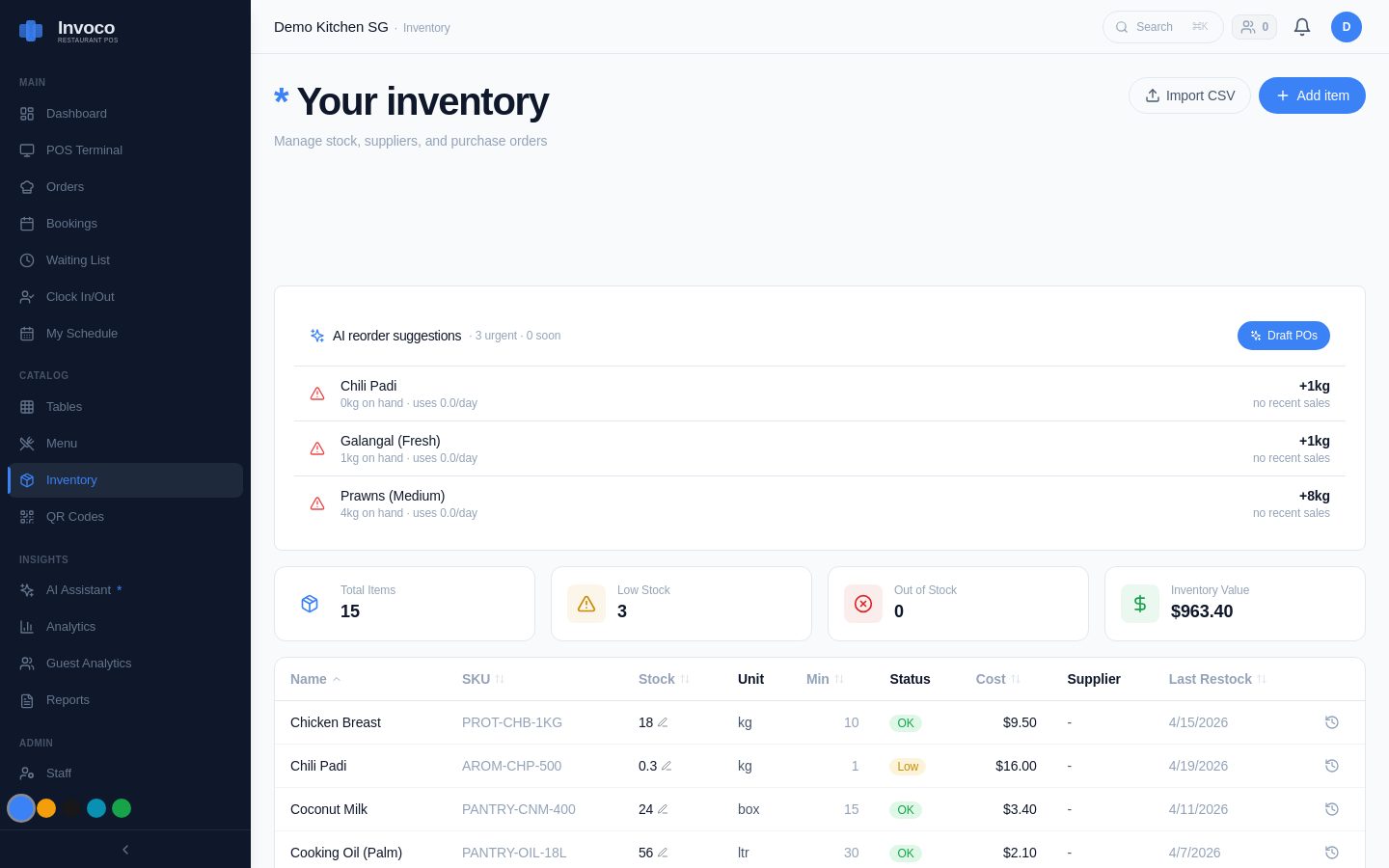 Invoco inventory management page tracking ingredients and stock levels
Start here. Singapore suppliers email PDFs or WhatsApp photos: FairPrice Wholesale, Tee Yih Jia frozen foods, or wet market fishmongers.
Qashier and Square demand line-by-line typing. Instead, use AI OCR tuned for SG formats—recognises GST breakdowns, HDB supplier letterheads.
1. Snap or forward the invoice. 2. Upload to your system. Gemini-style AI highlights line items: "Pork collar 5kg @ S$8.50/kg, GST 9%". 3. Approve extracts. Stock posts at invoice price; old inventory averages in.[3]
NxtEdge flags price hikes instantly across vendors.[5] For a Tanjong Pagar ramen joint, this catches a S$0.45/kg bone increase before it hits recipes.
Link this to inventory management for perishable items Singapore F&B guide for FIFO on perishables like prawns.
Step 2: Link Invoices to Recipe Costing
With prices live, recipes auto-update. Pre-seed 67 SG staples: sambal belacan, kaya, char siew pork.
Step-by-step workflow: 1. Build recipes once: Laksa base = 200g prawns (S$12/kg) + 100g coconut milk (S$2.80/L) = S$4.16/portion. 2. Invoice hits: prawns to S$13.50/kg. System recomputes: S$4.61/portion (+11%). 3. Flags over-budget items. Suggest menu price: from S$12.80 to S$13.50 for 30% GP.
Recipe Costing Software tracks this real-time, comparing vendors.[2][7] Oddle users manually export CSV; this is seamless.
IRAS requires accurate COGS for GST claims—auto-updates ensure IRAS-compliant bookkeeping/what-is-gst-/gst-treatment-of-input-tax-and-output-tax).[iras]
Step 3: Run Variance Reports & Adjust Menus
Post-update, check COGS variance: beginning stock + purchases - ending stock = true food cost %.
- Normal: 30-35% for cafes.
- Alert: ikan bilis over 4% variance? Kitchen portion creep.
Posist offers real-time tracking here, standardising recipes.[3] Integrate with how to calculate portion cost Singapore step-by-step guide for precision.
For multi-outlet like a Bedok Reservoir chain, row-level security keeps data siloed.
Step 4: Claim Productivity Grants
IMDA's Productivity Solutions Grant covers 50% of eligible tech up to S$30k. Recipe costing + OCR qualifies if it cuts manual labour.[imda]
Enterprise Singapore lists automation tools; apply via GoBusiness for hawker upgrades.[enterprisesg]
=How Invoco Handles Supplier Price Automation=
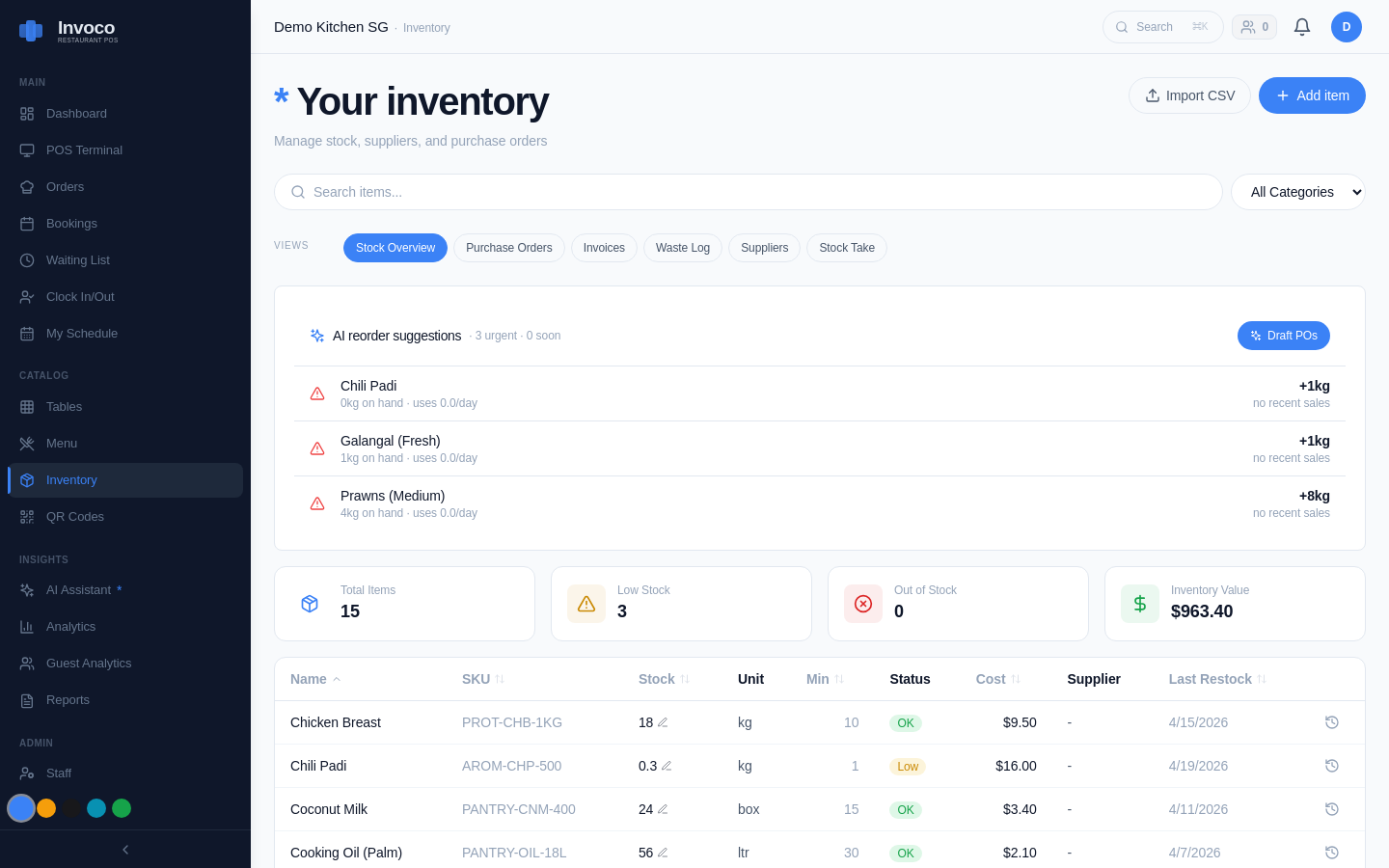 Invoco inventory management screen with low-stock warnings for key ingredients like prawns, galangal, and chili padi, plus AI-driven reorder suggestions
 Invoco menu management page with categorised items and prices
=Your pain: weekly supplier chats, Excel recipe sheets outdated by Friday lunch rush. Invoco fixes this with AI invoice OCR + inventory/recipe costing. Snap a Jurong fishmonger invoice—Gemini pulls line items with highlights. Approve, and it posts stock at new prices. Weighted-average costing auto-recomputes all recipes: that S$0.30/kg squid hike ripples to 23 menu items instantly. Link to POS with Xero integration Singapore sync sales to accounting for IRAS-ready bills. Outcome? Tanjong Pagar ramen boss cuts manual updates from 5 hours to 20 minutes weekly, spotting a 3.2% food cost creep early. Invoco.=
Troubleshooting Common Hiccups
OCR misses GST? Train with 3 samples; SG formats (9% GST post-2024) are pre-tuned.[3]
Prices wrong post-average? Check beginning stock counts—link to reduce theft in restaurant inventory Singapore 7 steps.
Multi-vendor? Weighted average smooths: 60% old S$8/kg chicken + 40% new S$9.20 = S$8.48 blended.[2]
SFA compliance: Auto-logs lot codes from invoices for traceability. No more paper trails.[sfa]
Beyond Basics: AI Agents & Vendor Compare
Advanced: conversational AI asks "Which ingredients over budget?" Flags pork from Supplier A vs B.[4][5]
NxtEdge compares real-time; pair with inventory software with recipe costing for Singapore F&B for full stack.
Restaurants automating procurement cut waste 25-40%, stockouts 80%.[1] For your HDB void deck zi char, that's S$800 monthly saved.
SFA mandates safe handling; automated tracking boosts compliance.[sfa]
FAQ
Q: Does this work for hawker stalls? A: Yes—compact tablet OCR, PayNow supplier payouts. S$49/mo entry.best POS for hawker stalls Singapore 2026 space budget speed
Q: Free alternatives? A: Google Sheets scripts exist, but no OCR. Misses 2-3 hours/week.
Q: Multi-outlet sync? A: Central dashboard, outlet-specific prices. Xero pushes bills.[26]
Sources
- Restaurant Supplier Automation 2026: End Stockouts and ...
- Real-Time Tracking of Updated Vendor Pricing with Recipe Costing ...
- Supply Chain Operations Transformation: Singapore Restaurants ...
- AI for Restaurants in Singapore: Cut No-Shows, Automate Orders ...
- How NxtEdge Uses AI to Help Restaurants Compare Vendors and ...
- Automating Supplier Price List Updates - YouTube
- Recipe Costing Software for Singapore F&B: Boost Profit Margins
- Food Service Distribution Software - Capterra Singapore
- Kitchen Automation for Singapore Restaurants | Boost Efficiency ...