How to Calculate Portion Cost Singapore: Step-by-Step Guide
Learn how to calculate portion cost in Singapore restaurants: detailed steps for recipe costing, real Hainanese chicken rice example at S$4.20 COGS, benchmarks for hawker stalls to CBD bistros. Boost margins without guesswork.
How to Calculate Portion Cost Singapore: Step-by-Step Guide
You're prepping Hainanese chicken rice at your Neil Road zi char stall, poaching a 2kg chicken from wet market for S$12.80/kg. But how much does one portion cost exactly? Most owners guess, ending up with 35%+ food costs that squeeze margins amid rising NTUC FairPrice prices and 9% GST.[7]
This tutorial breaks it down with real 2026 SGD numbers. You'll calculate exact portion costs for any menu item, target 28-32% food cost percentages ideal for Singapore hawker centres and kopitiams,[1][4] and price menus to cover rent at HDB void decks or CBD outlets. No spreadsheets needed beyond a phone calculator—though we'll cover automation later.
Why Portion Cost Matters for Your SG Kitchen
 Invoco kitchen display system showing active tickets with prep timers
In Singapore, food costs eat 25-35% of revenue for quick-service spots like bubble tea kiosks in Jurong Point or ramen shops in Tanjong Pagar.[1][5] Exceed 32%, and you're bleeding cash on shrinkage, over-portioning, or supplier hikes—common when chilli crab shells pile up uneaten.
Portion cost is the raw ingredient expense per single menu serving. Formula: Portion Cost = Sum of (ingredient unit cost × grams per portion).[2][3] Food cost percentage follows: (Portion Cost / Selling Price) × 100.[1][3]
Hawker stalls aim 25-30%; fine-dining bistros 35-40% due pricier imports.[1] Track this weekly via beginning inventory + purchases - ending inventory / total food sales to catch variances like overused ikan bilis.[2]
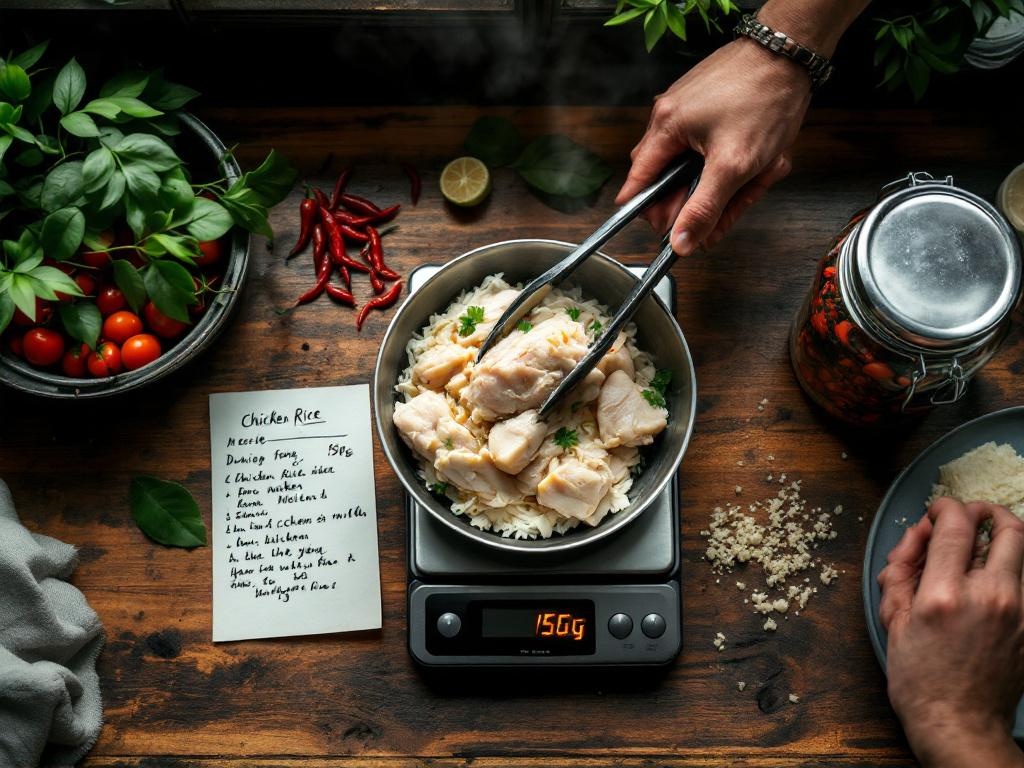
Invoco tip: Weigh portions during prep with a S$20 kitchen scale—your phone notes app tracks grams until you digitise.
Step 1: List Recipe Ingredients and Exact Weights
Take Hainanese chicken rice (1 portion: 150g steamed chicken, 200g rice, 50g cucumber, 30g chilli).
Grab supplier invoices: Poached chicken S$12.80/kg (wet market Bugis), jasmine rice S$2.50/kg (FairPrice), cucumber S$1.80/kg, sambal chilli S$8/kg (custom blend).
Pro tip: Use weighted-average costing if prices fluctuate—e.g., last invoice S$12 vs new S$13.50/kg.[brand context]
| Ingredient | Grams per Portion | Unit Cost (S$/kg) | Cost per Gram | Portion Cost |
|---|---|---|---|---|
| Chicken | 150g | 12.80 | 0.0128 | S$1.92 |
| Rice | 200g | 2.50 | 0.0025 | S$0.50 |
| Cucumber | 50g | 1.80 | 0.0018 | S$0.09 |
| Chilli | 30g | 8.00 | 0.0080 | S$0.24 |
| Total | S$2.75 |
Adjust for waste: Add 5-10% for trimmings (chicken bones).[4]
Step 2: Calculate Total Portion Cost
Portion Cost = S$1.92 (chicken) + S$0.50 (rice) + S$0.09 (cucumber) + S$0.24 (chilli) = S$2.75.[2][3]
Scale up: If chicken yields 13 portions (2kg at 150g each, minus 10% trim), true cost S$4.20 after full bird accounting.[4]
Invoco tip: Pre-portion proteins during bulk prep—your kitchen display system (KDS) flags if woks serve oversized 180g pieces.
Step 3: Set Selling Price Using Target Food Cost
Target 30% for zi char (hawker benchmark).[1][4]
Selling Price = Portion Cost / Target Food Cost % = S$4.20 / 0.30 = S$14.
Round to S$14.80. Check: (S$4.20 / S$14.80) × 100 = 28.4%—spot on.
Compare: Qashier POS users manually enter recipes but lack auto-variance; Eats365 handles modifiers well for split bills yet requires spreadsheet exports for costing.[competitor mention]
Step 4: Track Weekly Food Cost Percentage
End-of-week: Beginning inventory S$1,200 + purchases S$3,500 - ending S$1,100 = S$3,600 COGS.
Total sales S$12,000: Food Cost % = (S$3,600 / S$12,000) × 100 = 30%.[2][5]
Flag overages: If rice usage spikes, check par-cooked batches.
For GST: Portion costs exclude 9% GST on sales—net revenue for margins.[7] IRAS requires accurate COGS for deductible expenses; sloppy tracking risks audits.[IRAS link]
Step 5: Adjust for Shrinkage and Seasonals
Monsoon rots 15% cucumbers? Add buffer. Chinese New Year prawn S$28/kg? Recalculate laksa portions.
SFA hygiene rules mandate dated stock rotation—first-in-first-out prevents S$200 weekly toss-outs.[SFA link]
How Invoco Handles Portion Cost Calculation
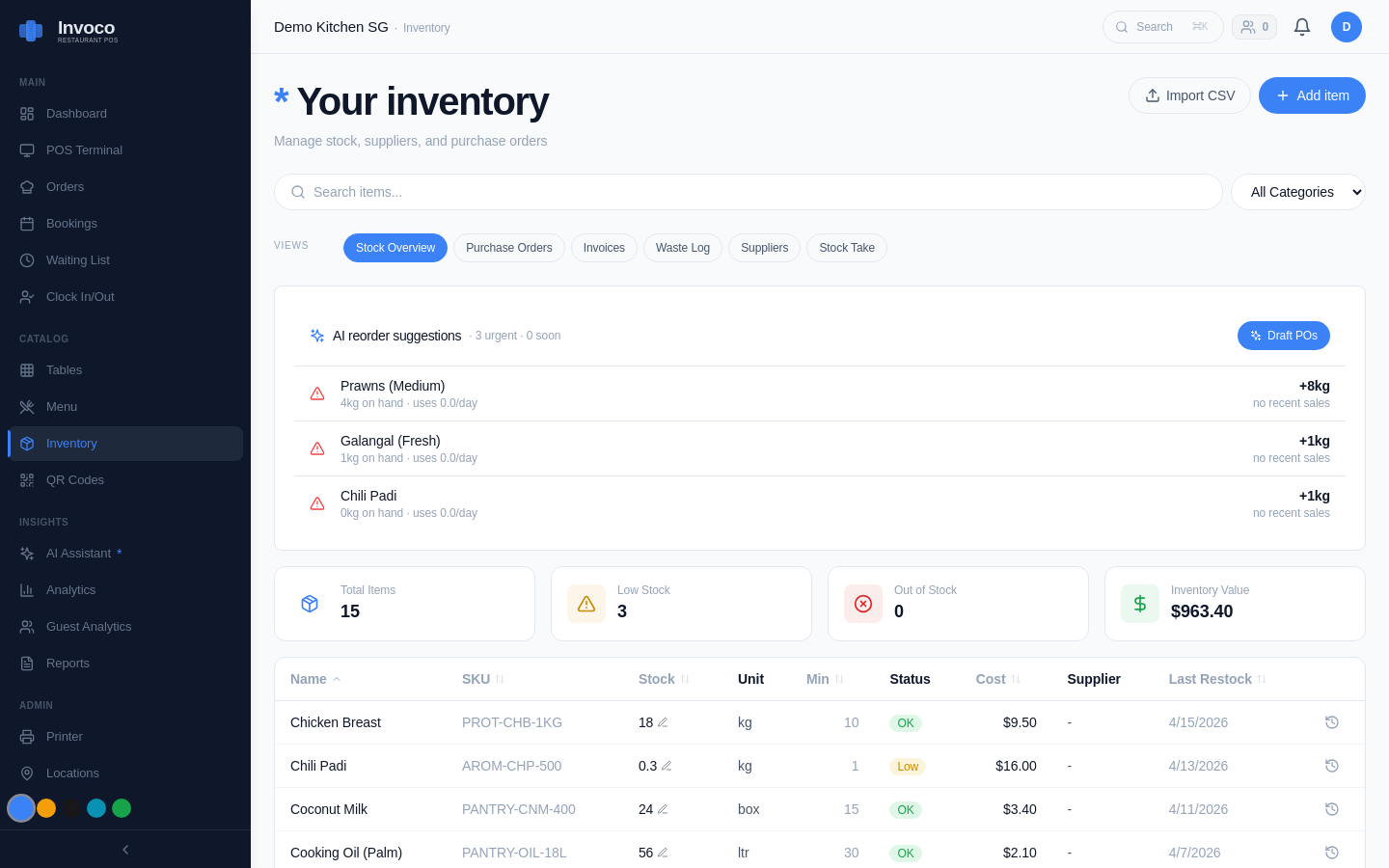 Invoco inventory management page tracking ingredients and stock levels
You're juggling wet market receipts at your Tiong Bahru cafe, manually summing laksa portion costs in Excel while staff clock in late. Invoco changes that with its Inventory + recipe costing module: seed 67 canonical SG ingredients like pandan and belacan at weighted-average costs.
Upload supplier PDFs via AI invoice OCR—Gemini extracts line items (e.g., 5kg ikan bilis S$45), auto-posts to stock at exact prices. Link recipes (200g rice + 150g chicken per portion), and it recomputes costs instantly when NTUC hikes hit. The COGS + ingredient variance report flags over-usage: "Rice 8% over budget this week." Multi-outlet chains see row-level data per location.
Outcome: A Jurong Point bubble tea kiosk cut costing time from 4 hours to 15 minutes weekly, holding food costs at 27% despite tapioca surges. Invoco
Troubleshooting Common Mistakes
1. Forgetting garnishes: Sambal packet? S$0.10 extra. 2. Unit mismatches: Buy rice in 10kg bags? Divide total S$25 / 10,000g. 3. No waste factor: Always +7% for peels, shells.
Read our inventory software with recipe costing for Singapore F&B for deeper variance tracking. For multi-outlet, check best inventory software for multi-outlet F&B in Singapore.
PSG grant covers 50% of POS like this—up to S$30k. PSG guide.
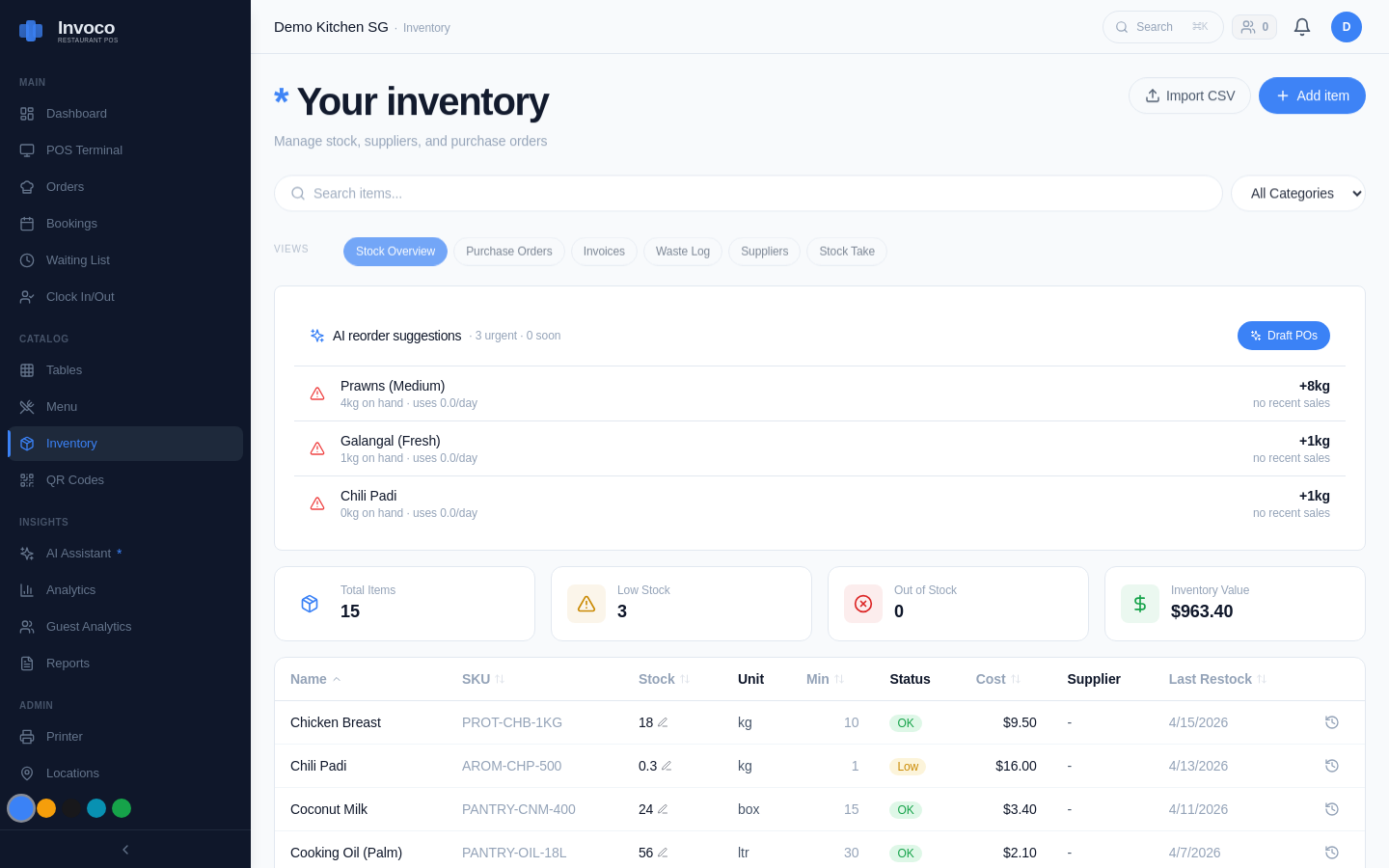 Invoco inventory management screen displaying ingredients table with low-stock warnings, unit costs, and AI reorder suggestions for precise portion costing
FAQ
What's a good portion cost % for hawker stalls? 25-30%—e.g., S$3 cost on S$12 plate.[1]
Include labour in portion cost? No, that's prime cost (food + labour 60-65%).
How often recalculate? Monthly or post-supplier hike.
Sources
- Calculating Food Cost Percentage for Restaurant Profitability
- How Do You Calculate Your Food Cost? | iCHEF CLUB SG
- How to Calculate Food Cost Percentage - Escoffier
- How To Nail Your Singapore Restaurant's Menu Pricing
- How To Price Your Restaurant Menu Using Food Cost Calculation
- How To Calculate Margin Cost For Food And Beverage Business
- How to Calculate GST and Service Charge in Singapore (2025)