Reduce Food Waste in Singapore Restaurants: Inventory & Portion Tips
Practical guide to reduce food waste in Singapore restaurants using inventory forecasting, portion control, FIFO, and par levels. Save S$500-2k monthly on spoilage for hawker stalls and cafes.
Reduce Food Waste in Singapore Restaurants: Inventory & Portion Tips
Your bubble tea kiosk at Jurong Point just binned S$450 of wilting pearls and excess tapioca syrup last week because the lunch crowd ghosted after school holidays. Multiply that across 30 days, and you're leaking S$1,200 monthly—enough to cover a part-time barista's CPF.[1] In Singapore's F&B scene, where NEA hawker rents hit S$1,500 at prime spots and SFA demands fresh stock for food safety, food waste isn't just sloppy; it's a margin killer.[2]
This tutorial breaks down four inventory and portion tactics that hawker uncles, kopitiam bosses, and CBD bistro owners use to slash waste by 30-40%.[1][3] No fancy AI needed at first—start with FIFO rotation and par levels on your existing spreadsheet, then layer in forecasting from POS sales data. Expect S$500-1,500 savings monthly for a S$50k-revenue outlet, based on real SG operator benchmarks.[1][4]
Step 1: Rotate Stock with FIFO to Kill Spoilage
 Invoco kitchen display system showing active tickets with prep timers
First-In, First-Out (FIFO) means oldest stock gets used first. In humid Singapore kitchens, where walk-ins hit 28°C if the compressor lags, greens wilt overnight.[1]
Do this today: 1. Label every container with arrival date using masking tape and a Sharpie—"Veg 25/4/26". 2. In your dry store and chiller, slide older packs to the front shelf, shove new deliveries to the back. No digging. 3. Train cooks: "Grab front first, or you're paying for it." Spot-check weekly during morning prep.
A ramen shop in Tanjong Pagar cut lettuce waste from 15kg to 3kg weekly this way, saving S$180/month at S$6/kg wholesale.[1] SFA's food hygiene rules back this: proper rotation prevents cross-contamination from spoiled stock.[2]
Invoco tip: Link recipe costing to expiry dates so your laksa paste never sits past its prime.
Step 2: Set Par Levels to Stop Overstocking
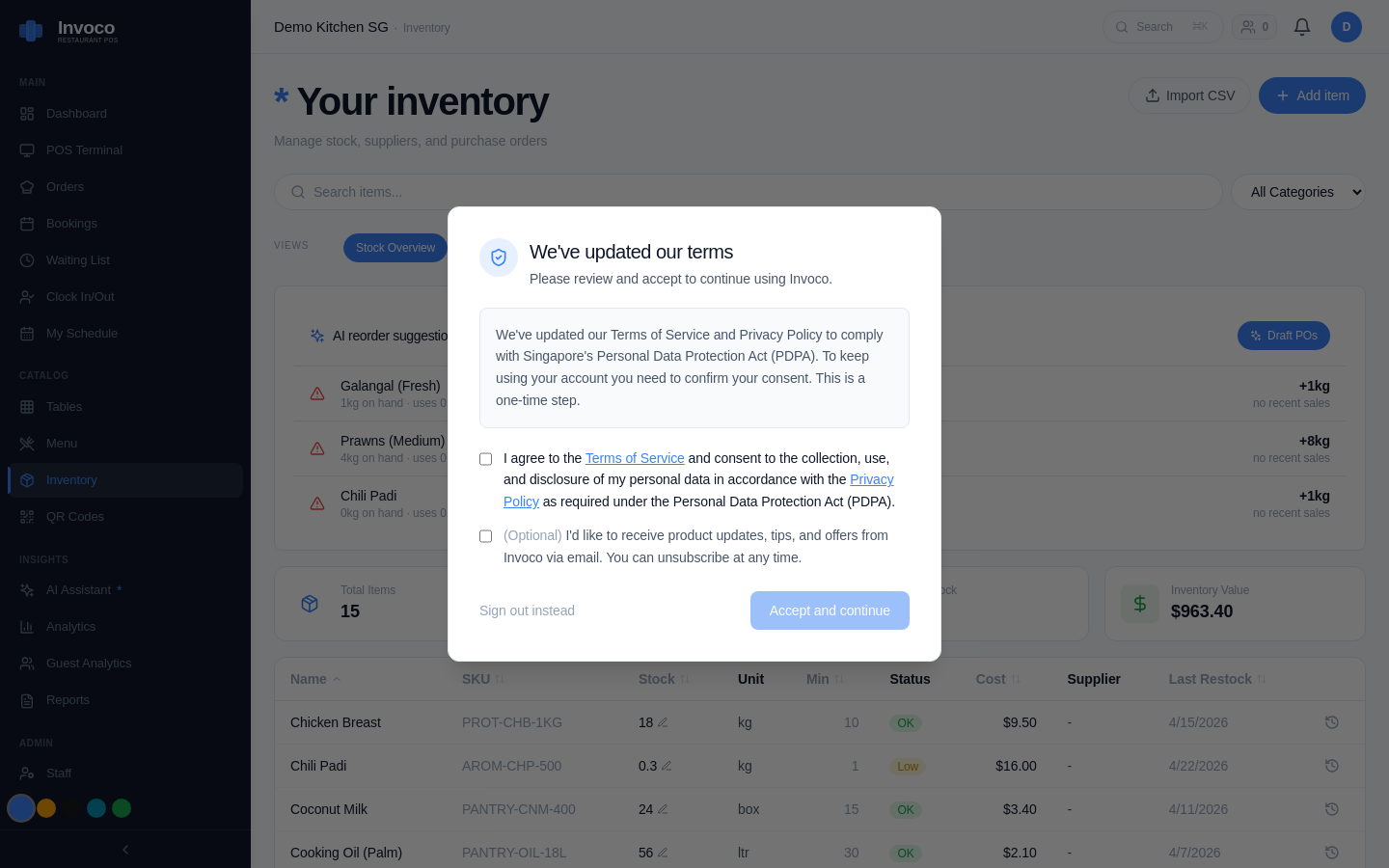 Invoco inventory dashboard with low-stock warnings for Prawns, Galangal, and Chili Padi, including AI reorder suggestions and stock levels
Par levels are your minimum reorder stock—e.g., 10kg onions daily for a 100-pax zi char stall. Guess wrong, and you overbuy perishables.[1][6]
Calculate yours: 1. Track usage: Weigh onions used over 7 days (busy + slow). Say 8kg Mon-Fri, 12kg Sat. 2. Set par: Average daily use x 2 days buffer = 20kg for weekdays. 3. Weekly review: Adjust for events like NDP or school hols via your POS sales report.
For a HDB void deck chicken rice stall, par levels dropped rice waste from S$250 to S$60/month. Use a simple Excel or graduate to inventory software with barcode scanning Singapore F&B for auto-alerts.[6]
NEA's zero-waste push for hawker centres rewards this: top performers get rental rebates up to 20%.[2] Check NEA hawker sustainability for grants.
Step 3: Track Waste Logs to Pinpoint Leaks
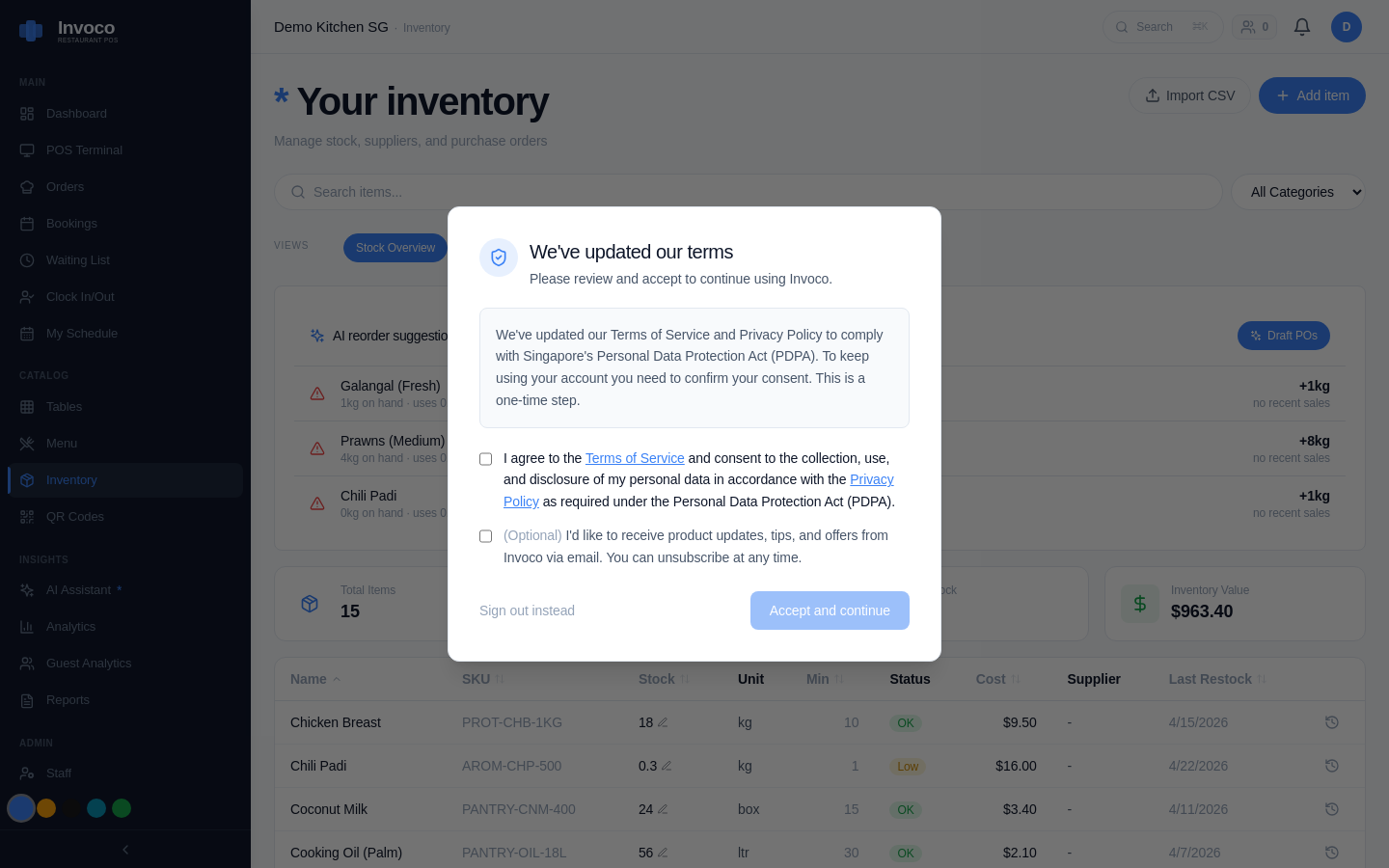 Invoco inventory management page tracking ingredients and stock levels
Log every binning: "2kg prawns, spoiled, 27/4/26." After two weeks, patterns emerge—e.g., over-prepped sambal on slow Mondays.[1][6]
Build the log: 1. Shared Google Sheet: Columns for date, item, kg, reason (spoiled/prep error/theft), cost/kg. 2. Kitchen lead signs off daily before close. 3. Monthly tally: If prawns hit S$300 waste, cut order by 30% next cycle.
Competitors like Qashier and Eats365 do sales tracking well, but their inventory stops at basics—no variance reports flagging prawn over-usage. A Bedok kopitiam boss logged waste and trimmed S$900/month, redirecting to CPF top-ups.[1][4]
Tie this to inventory management for perishable items: Singapore F&B guide for perishables like bak choy or tauhu.
How Invoco Handles Your Waste Tracking
You're juggling WhatsApp supplier quotes, paper invoices, and Excel tallies that never match end-of-day stock—leading to blind over-orders and S$1k monthly toss-outs. Invoco[https://pos.invoco.org]'s Inventory + Recipe Costing module fixes this: seed your 20 key ingredients (ikan bilis to serai), link to menu recipes, and it auto-computes costs with weighted-average pricing. Upload supplier PDFs to AI Invoice OCR—it extracts line items at invoice price, posts to stock on approval. The COGS + Variance Report runs "beginning + purchased - ending" to flag over-usage per item, like 15% extra on your char siew. Xero integration pushes bills with IRAS-correct GST. Result: a Tanjong Pagar cafe dropped waste 35%, freeing 4 hours weekly for family time.==
Step 4: Forecast Demand and Nail Portions
Forecasting beats gut feel. Use POS data: Last April's 120 bowls laksa? Order for 110 this month, adjust for Good Friday.[3][5]
Portion control steps: 1. Recipe cards: "150g rice per plate, 30g sambal." Use scoops (#8 for 1oz) and scales. 2. Train: Weekly demos, then spot-check plates. 3. Forecast: Average sales x ingredient yield. E.g., 100 chicken rice uses 15kg chicken—order 16kg buffer.
AI tools claim 30-40% waste cuts, but start free: Export POS sales to Sheets.[3] For festive spikes, see how to forecast inventory for festive seasons Singapore F&B. IMDA's Productivity Solutions Grant covers 50% of forecasting software up to S$30k.[3]
Enterprise Singapore grants fund waste trackers—apply via GoBusiness.
Troubleshooting Common Hiccups
Staff ignore FIFO? Incentive: Waste leader buys kopi for the team. Forecasts miss rainouts? Blend POS history with PredictHQ events (e.g., F1 traffic).[10] Portions creep up? Daily weigh 10 plates, adjust recipes.
Oddle excels at QR ordering but lags on inventory variance; Lightspeed does POS but manual stock entry slows you. Invoco's edge: auto-recompute costs when sio bak prices jump 10%.[1][4]
Track how to calculate portion cost Singapore: step-by-step guide for precision.
Quick FAQ
How much waste is normal for SG hawkers? 4-10% of purchases; aim under 5% with these steps.[1] SFA fines for waste? No direct, but spoilage risks hygiene demerits.[2] Grants for inventory tools? Yes, IMDA PSG up to S$30k.[3]
Sources
- Inventory Techniques to Reduce Food Waste in Restaurants | Supy
- The Ultimate Guide to Reducing Food Waste in Restaurants
- AI Demand Forecasting for Restaurants: Cut Food Waste & Boost ...
- How Restaurant Tech Reduces Food Waste and Boosts Profits
- Fine Tuning Restaurant's Inventory to Optimize Food Waste
- How Real Time Inventory Management Reduces Food Waste and ...
- Food Waste Tracker with Demand Forecasting | SMEs Go Digital
- AI-Powered Demand Forecasting: Tackling Food Waste
- NTU develops AI model to track food freshness to reduce waste ...
- Reduce food waste with smarter supply chain forecasting - PredictHQ