Calculate Labor Cost Percentage Singapore: Step-by-Step Guide
Step-by-step guide to calculating labor cost percentage for Singapore restaurants, hawker stalls, and cafes. Includes benchmarks and optimization tips.
Your zi char stall in Tiong Bahru just paid out $4,200 in wages last month. Sales hit $14,000. You have no idea if that's sustainable—or if you're bleeding money on payroll.
Labor is your second-largest expense after food cost. Unlike ingredient prices, which fluctuate weekly, payroll is often the one number F&B operators don't track properly. You pay staff, you move on. But without knowing your labor cost percentage, you can't tell if you're pricing dishes high enough, scheduling too many shifts, or simply running an unprofitable operation.
This guide walks you through the calculation, shows you what Singapore F&B benchmarks actually are, and gives you concrete steps to optimize.
The Formula: Labor Cost Percentage
The calculation is straightforward[1]:
(Total Labor Costs ÷ Total Sales) × 100 = Labor Cost Percentage
Using the Tiong Bahru example:
- Total labor costs (wages, overtime, CPF): $4,200
- Total sales: $14,000
- $4,200 ÷ $14,000 = 0.30
- 0.30 × 100 = 30%
That means 30 cents of every dollar you earn goes to paying and supporting your team.
What Counts as Labor Cost?
Don't just add up wages. Include[2]:
- Hourly wages and salaries
- Overtime pay
- Bonuses
- CPF contributions (employer portion—currently 17% for workers aged 55 and below)
- Health insurance or benefits
- Vacation and sick pay (if you offer it)
- Payroll taxes
If you're using a POS system with labor tracking, it should pull shift data automatically. If you're on spreadsheets, ask your accountant to confirm CPF and tax components.
Invoco tip: Most Singapore F&B operators forget CPF when calculating labor cost—it's 17% on top of wages, so a $2,000 monthly salary actually costs you $2,340.
Singapore F&B Labor Cost Benchmarks
Industry standards vary by segment[3][4]:
| Segment | Target Labor Cost % | Notes |
|---|---|---|
| Hawker stall | 15–25% | Lean team, owner often works the line, low rent |
| Cafe | 20–28% | More skilled baristas, longer hours, moderate rent |
| Casual restaurant | 25–32% | Waitstaff, kitchen team, moderate rent |
| Fine dining | 30–35%+ | Specialized labor, table service, higher rent |
| Fast food / QSR | 20–28% | High volume, standardized roles, efficient scheduling |
Most Singapore F&B operators should aim for 25–32%[5]. If you're consistently above 35%, you're either understaffed (risking service quality) or overstaffed (bleeding margin).
Step-by-Step Calculation
 Invoco orders page with active and completed tickets
Step 1: Choose Your Time Period
Calculate monthly. It's frequent enough to spot trends but stable enough to avoid noise from single-day swings. Avoid weekly—too volatile. Avoid annual—too slow to act on.
Step 2: Gather Total Sales
Pull your sales report from your POS system. This should include:
- Dine-in sales
- Takeaway sales
- Delivery sales (if applicable)
- Exclude refunds and voids
If you're still on cash register + spreadsheet, total your daily tapes and add them up. If you use PayNow and credit card payments, your POS should reconcile both.
Step 3: Sum All Labor Costs
For the same month:
- Pull payroll records (wages, overtime)
- Add CPF employer contribution (17% of gross wages for most workers)
- Add bonuses or allowances paid that month
- Add payroll taxes (if any)
- Add benefits (health insurance, meal allowances)
Example for a small cafe:
- 2 baristas @ $2,000/month = $4,000
- 1 part-timer @ $800 = $800
- CPF (17% on $4,800) = $816
- Subtotal: $5,616
Step 4: Divide and Convert
Labor cost % = ($5,616 ÷ $20,000 sales) × 100 = 28.08%
That cafe is within the 20–28% benchmark for cafes—healthy.
Step 5: Track Month-on-Month
Don't calculate once and forget. Track it every month in a simple spreadsheet:
| Month | Sales | Labor Cost | % | Notes |
|---|---|---|---|---|
| Jan | $18,500 | $5,200 | 28.1% | Normal |
| Feb | $16,200 | $5,100 | 31.5% | Chinese New Year, fewer customers |
| Mar | $21,000 | $5,400 | 25.7% | Hired extra shift, sales picked up |
Trends matter more than a single month.
How to Optimize Your Labor Cost Percentage
 Invoco POS terminal checkout view with menu and payment options
1. Align Scheduling to Demand
If your lunch rush is 11 AM–1 PM and dinner is 6 PM–8 PM, don't staff 3 PM–5 PM heavily. Use your POS sales data to identify peak hours, then schedule accordingly. A hawker stall in Jurong Point might need 2 staff during lunch but only 1 during mid-afternoon.
2. Cross-Train Staff
A barista who can also handle the register, or a kitchen hand who can prep and plate, reduces the headcount you need. This is especially valuable in small cafes and stalls.
3. Review Overtime
Overtime is expensive. If you're consistently paying overtime, you may be understaffed or over-scheduling. Hire a part-timer instead, or adjust shifts.
4. Automate Where Possible
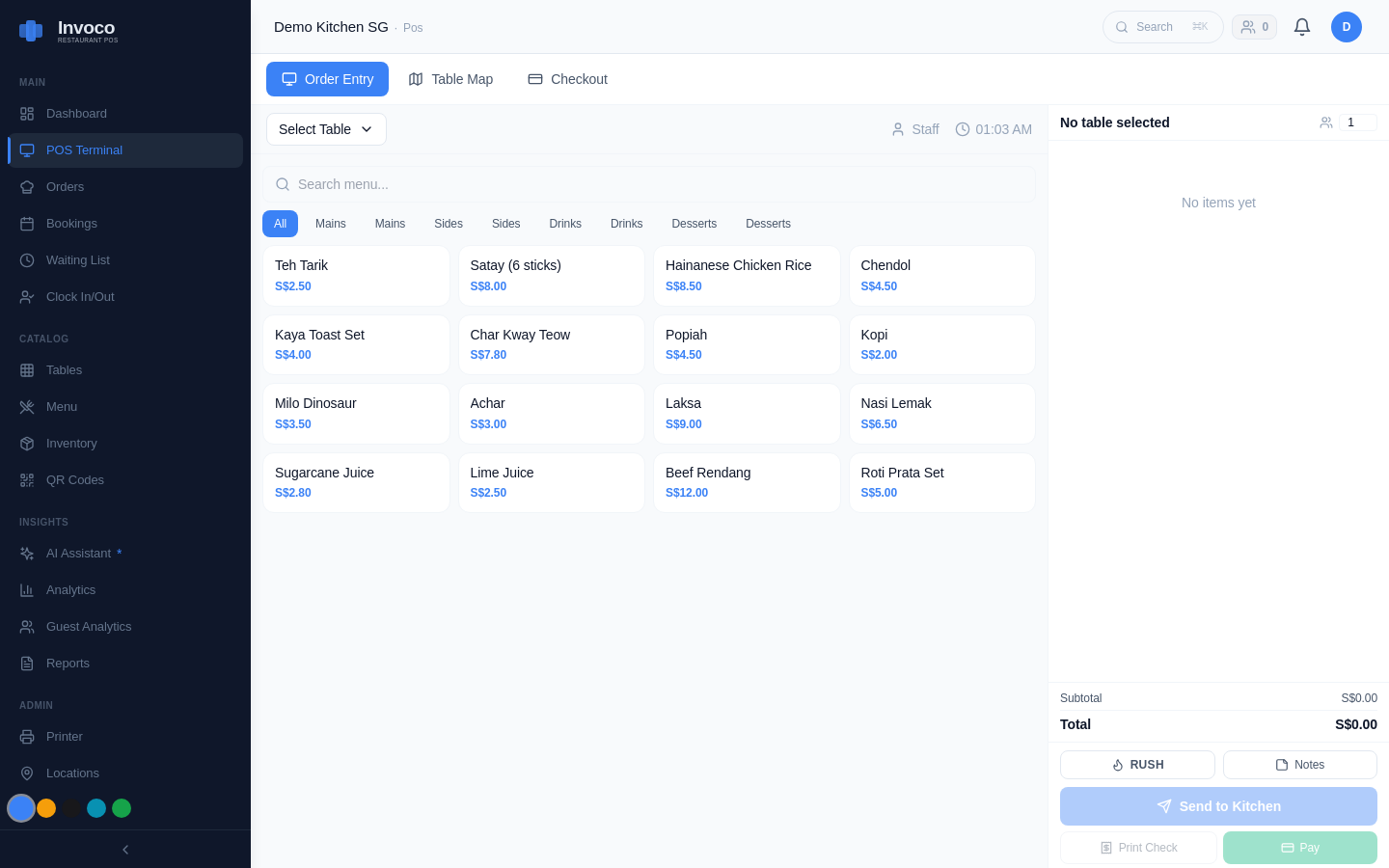
Using a POS with QR code ordering or table management can reduce the need for a dedicated order-taker or host, freeing up labor for the kitchen or service. This is especially valuable for multi-outlet chains.
5. Monitor Food Cost Alongside Labor
Labor cost and food cost together make up your "prime cost." If labor is 28% and food cost is 32%, your prime cost is 60%—leaving 40% for rent, utilities, and profit. If either creeps up, the other must come down. Understanding your portion cost helps you price dishes to hit your food cost target, which then determines how much you can afford to spend on labor.
How Invoco Helps You Track Labor Cost
 Invoco dashboard displaying revenue KPIs, orders, and upcoming bookings for labor cost tracking context
Invoco's staff clock-in module with PIN-based shift tracking lets you record when each team member starts and ends their shift, automatically calculating hours worked. Combined with your sales data from the POS, you can generate a monthly labor cost report without manual spreadsheet work. The system flags when labor cost drifts above your target, so you can adjust scheduling or pricing before the problem compounds. This is especially useful for multi-outlet operators who need to compare labor efficiency across locations.
Common Mistakes to Avoid
Forgetting CPF. Many operators calculate wages only, forgetting the 17% employer CPF contribution. This understates your true labor cost by ~15%.
Mixing time periods. Don't compare January wages against February sales. Always use the same month.
Excluding salaried staff. If you pay yourself a salary, include it. If you don't, your labor cost is artificially low and not comparable to other businesses.
Ignoring part-timers and casual workers. Every dollar paid to staff counts, regardless of contract type.
FAQ
Q: My labor cost is 22%. Is that good? A: It depends on your segment. For a hawker stall, 22% is excellent. For a casual restaurant, it's slightly low—you might be understaffed or at risk of burnout. For a cafe, it's good. Compare against your segment benchmark.
Q: Should I include my own salary? A: Yes, if you want an accurate picture of profitability. If you don't include it, your labor cost looks artificially low, and you won't know if the business can actually support a manager's salary.
Q: My labor cost spiked to 35% last month. What do I do? A: First, check if it was a one-off (e.g., extra staff for an event, or lower-than-usual sales). If it's trending upward, review scheduling, overtime, and whether you're pricing dishes high enough to cover your staffing model.
Sources
- Restaurant Labor Cost Percentage: How To Calculate It And Keep It ...
- Standard Food and Beverage Costs | FHA-FNB
- Restaurant Labor Cost Percentage: How to Calculate and Reduce It
- How to Calculate Food Cost for Your F&B Business in Singapore
- How To Calculate Labor Costs: Key Metrics For Restaurants
- Calculating Food Cost Percentage for Restaurant Profitability
- How Do You Calculate Your Food Cost? | iCHEF CLUB SG
- What contributes to staffing costs and how to reduce them in F&B