How to Calculate Break-Even Point for New Cafe Singapore
Calculate break-even point for your new Singapore cafe using POS sales data. Step-by-step with 2026 Tanjong Pagar example: S$45k fixed costs, 65% margin needs S$70k monthly sales to cover rent, CPF, GST.
How to Calculate Break-Even Point for New Cafe Singapore
Your new cafe in Tanjong Pagar's HDB shophouse needs to hit S$8,500 in daily sales to break even—or you'll bleed cash by month two. That's based on real 2026 numbers: S$45,000 monthly fixed costs, 32% food costs, and S$12 average receipt from 700 customers a day.
Most cafe owners guess at this and fail. You won't. This tutorial uses POS sales data to nail your exact threshold, pulling in IRAS GST rules, MOM CPF contributions, and SFA licensing fees. We'll walk through a bubble milk tea and toast cafe example, then show how to automate it weekly.
Step 1: List Your Fixed Costs (The Non-Negotiables)
 Invoco orders page with active and completed tickets
Fixed costs don't budge with customer count. For a 50-seat cafe near Tanjong Pagar MRT, expect these in 2026:
- Rent: S$5,000–S$7,000 for 800sqft shophouse (higher in CBD).[8]
- CPF contributions: 17% employer share on S$20,000 payroll (MOM rates).[external link to MOM]
- Utilities base: S$800 (NEA water/sewerage).[external link to NEA]
- SFA licence: S$425/year for food shop + S$200 hygiene course.[external link to SFA]
- IRAS GST registration: 9% on sales over S$1m/year, but prep for output tax now.[external link to IRAS]
- POS subscription: S$49/mo (like Qashier or Invoco).[internal link]
- Insurance/marketing: S$500.
Total example: S$45,000/month. Track in Google Sheets or Xero—export from your POS end-of-day report.
Invoco tip: Pull fixed costs straight from your POS Xero sync to avoid double-entry errors.
Step 2: Nail Variable Costs from POS Data (Food + Labour)
Variables scale with sales. Use 4 weeks of POS reports:
- Food cost: 28–35% of sales. Toast sets at S$1.20 COGS on S$4.50 plate = 27%.[1][3]
- Labour: 25–30%. Part-timers at S$1,600/mo each, tied to covers.
- Packaging/waste: 3–5%.
Example: S$100,000 sales → S$32,000 food (32%) + S$28,000 labour = 60% variables. Contribution margin = 40% (sales minus variables).[1][2]
Pro move: Recipe costing in your POS flags overages. A ramen shop in the same block cut food cost 5% by tracking modifiers.[internal link to inventory software with recipe costing].
Step 3: Calculate Contribution Margin Ratio
This is your profit engine per dollar sold.
Formula: (1 - Variable Cost %) x 100
Example: 1. POS total sales: S$100,000. 2. Total variables: S$60,000. 3. Margin ratio: (S$100k - S$60k) / S$100k = 0.40 or 40%.[1][3][6]
Blended average: S$12 receipt (coffee S$5.50, toast S$4.50, extras S$2). Variable per receipt S$4.80 = S$7.20 margin.[3]
Step 4: Hit Break-Even (The Magic Number)
Formula: Fixed Costs ÷ Margin Ratio = Monthly Sales Needed.[1][2][4]
Plug in:
- Fixed: S$45,000
- Margin: 40%
- Break-even sales: S$45k ÷ 0.40 = S$112,500/month or S$3,750/day (30 days).
Units check: S$112,500 ÷ S$12 avg receipt = 9,375 customers/month or 313/day. At 50 seats x 2hr turnover x 12hrs = max 300. Tight—raise prices or cut rent.[3]
Tanjong Pagar Reality Check
A real 800sqft cafe there: S$6,500 rent, S$25k labour (4 FT + 6 PT), 65% margin target. Break-even drops to S$70k/mo (S$2,333/day, 194 customers).[8] Below 150/day? Rethink location or menu.
Step 5: Weekly POS Workflow to Track It
 Invoco analytics dashboard with revenue charts, top dishes ranked by sales, and category performance metrics
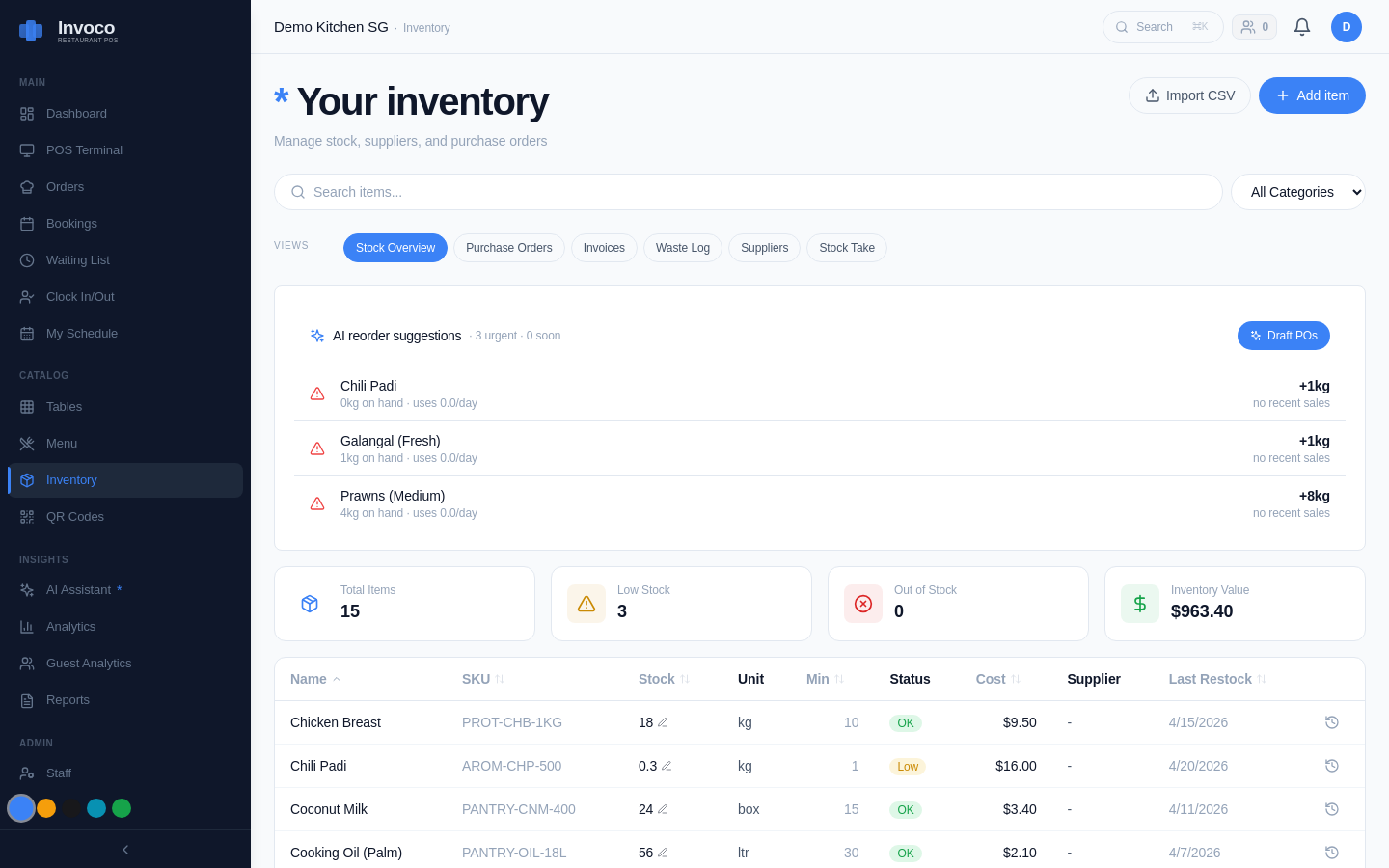 Invoco inventory management page tracking ingredients and stock levels
1. Sunday close: Export POS report (sales, items, staff hours).[internal link to automate end-of-day reports singapore-fb-pos-guide] 2. Monday: OCR supplier invoices → post to inventory at weighted avg cost. 3. Update sheet: Fixed (rent/CPF), variables (food % from COGS report). 4. Recalc: If margin slips to 35%, break-even jumps S$128k/mo. 5. Alert: POS flags if daily sales < S$3,750.
Compare to competitors: Qashier excels at cashless but manual costing; Oddle boosts online orders 20% but no variance reports. Lightspeed suits chains, overkill for your startup.[news]
How Invoco Handles Break-Even Tracking
You're juggling spreadsheets for that Tanjong Pagar cafe, watching food cost creep to 35% while rent eats 12% of sales. Invoco's Inventory + Recipe Costing module auto-recomputes every menu item's cost when supplier prices update via AI OCR—upload Atas invoice photo, approve line items, stock posts at exact price. The COGS + Variance Report shows "beginning + purchased - ending" food %, flagging over-usage on milk tea pearls. Link to Xero for IRAS GST bills, and query the AI agent: "What's my break-even at 65% margin?" Outcome: Weekly 15min checks replace daily tallies, spotting a S$2k/mo leak before it kills margins. Invoco==
Troubleshooting Low Margins
- Food >32%: Portion too big? Use how to calculate portion cost singapore step-by-step guide.
- Labour >28%: Track hours precisely[internal link to calculate labor cost percentage singapore step-by-step-guide]. MOM requires accurate CPF.[external link to CPF]
- Rent killer: Negotiate HDB void deck at S$3k vs shophouse S$6k.[external link to GoBusiness]
Grants tip: IMDA Productivity Solutions Grant covers 50% of POS like Invoco up to S$30k.[external link to IMDA]
FAQ
Q: What's realistic break-even for hawker stall cafe? A: S$4,500/day on S$8k fixed, 60% margin—250 bowls laksa at S$18k/mo.[NEA hawker data]
Q: How often recalculate? A: Weekly from POS, monthly for rent/CPF hikes.
Q: POS without costing? A: Switch to one with recipe tools—avoids 10% error in variables.[1]
Sources
- The Break-Even Point: A Key to Restaurant Financial Success
- Ultimate Guide to Calculating Break-Even Point for Restaurants
- Breakeven Formula Made Simple: A Café Owner's Guide
- How do you calculate the break-even point? - Stripe
- Break-Even Analysis for Restaurants: How to Calculate Your B.E.P.
- Restaurant Break Even Calculator | Restaurant365
- Formula to Calculate the Break-Even Point | Airwallex Singapore
- Financial Modeling for Singapore Cafés: Break-Even Guide
- How to Calculate the Break-Even Point for Your Restaurant - YouTube